Tire Wear to Riverbeds: How Pittsburgh Watersheds Trap Road Microplastics
Pittsburgh Steep Slopes and the Hidden Tide of Tire Dust
Pittsburgh”s hills are part of its identity, but they also shape a difficult stormwater problem. Roads climb and descend sharply through neighborhoods such as Mount Washington, Polish Hill, Fineview, and the South Side Slopes. During intense rain, water gathers on impervious pavement and moves rapidly downhill, carrying sediment, brake dust, oil residues, and microscopic tire wear particles toward inlets, pipes, creeks, and ultimately the Three Rivers. The practical implication for planners is clear: a road corridor is not merely a transportation surface. It is also a drainage basin with a direct connection to aquatic habitat.
Tire wear particles, often called TWPs, are generated continuously whenever vehicles accelerate, brake, turn, or travel over uneven pavement. They consist of synthetic rubber, polymers, mineral fillers, metals, and chemicals incorporated into tire compounds. Some particles settle in curb lines and parking areas, while others remain suspended in runoff. Pittsburgh”s Allegheny, Monongahela, and Ohio Rivers receive water from a densely developed watershed where steep grades, frequent storm events, and aging sewer infrastructure can compress the distance between roadway pollution and river water. A well-designed stormwater plan therefore needs to address both visible flooding and contaminants too small to see.
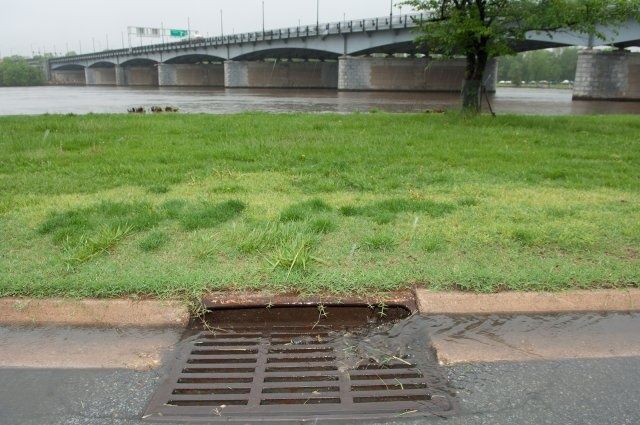
Why Traditional Curb and Gutter Systems Funnel Microplastics into the Three Rivers
Traditional curb and gutter systems were designed primarily to move water away from streets as quickly as possible. That approach made sense when the principal concern was keeping roads passable and preventing standing water near buildings. In a conventional corridor, a crowned pavement surface directs rain toward a curb, a grate collects the flow, and an underground pipe conveys it to a larger sewer or outfall. The system provides speed and predictability, but it offers little opportunity for sedimentation, biological uptake, or filtration.
The problem becomes more acute during heavy precipitation. Pittsburgh has extensive combined sewer areas in which sanitary sewage and stormwater share conveyance infrastructure. When rainfall exceeds system capacity, combined sewer overflows can discharge diluted sewage and roadway pollutants into nearby waterways. Even separated storm drains can carry untreated runoff directly to tributaries. The Allegheny County water pollution program oversees treatment facilities and sewer systems, but regulatory oversight does not transform every storm drain into a treatment device. Runoff that enters a pipe with tire dust remains a rapid pollutant delivery pathway.
According to the U.S. Environmental Protection Agency”s stormwater research, developed surfaces send a much greater share of rainfall into drains than forests, wetlands, or grasslands, where water can slow, infiltrate, and interact with soil. Conventional paved conduits therefore differ from natural catchments in several important ways:
- Hydraulic speed: Pipes and gutters move water quickly, while vegetated systems spread and slow the flow.
- Contact time: Concrete conveyance provides almost no time for particles to settle or bind to soil.
- Pollutant separation: A curb inlet collects water and solids together, whereas a treatment bed can retain sediment before infiltration.
- Peak-flow response: A direct connection transfers runoff peaks downstream, while distributed storage reduces the volume and velocity reaching tributaries.
Engineering the Sponge with Bioretention and Engineered Soils
Bioretention systems create a deliberately layered alternative to the direct pipe connection. A typical installation may include a surface depression, dense vegetation, engineered soil, a mulch or amended surface layer, an aggregate drainage zone, and an underdrain where native soils infiltrate too slowly. Water enters from a curb cut, swale, or paved surface, ponds briefly, and then moves through the media. The system is not simply a decorative rain garden. Its performance depends on carefully specified particle size, hydraulic conductivity, storage depth, overflow design, plant selection, and access for maintenance.
Engineered soils are especially important for tire wear particles because they combine physical straining with sedimentation and chemical interaction. Larger rubber fragments and road dust can settle at the surface or become trapped between soil grains. Smaller particles may attach to organic matter, mineral surfaces, and biofilms. Vegetation reduces flow velocity above the soil and contributes roots that stabilize the media. A permeable pavement system can add another interception layer beneath sidewalks, parking lanes, or low-speed areas. Laboratory research on permeable pavements found that microplastics accumulated primarily near the surface and in geotextile layers, with reported retention efficiencies ranging from 89 percent to 99.6 percent under the tested conditions. The findings are detailed in the permeable pavement layer study, though field performance will vary with rainfall intensity, clogging, particle size, and maintenance.
Concrete sewers remain essential for conveyance, particularly in dense streets and during extreme events, but their role changes when paired with upstream treatment. The strongest design is usually a treatment train rather than a single installation.
| System element | Primary function | Relevance to tire particles |
|---|---|---|
| Curb extension or inlet planter | Receives and slows roadway runoff | Captures coarse road dust and larger rubber fragments |
| Vegetated bioretention surface | Reduces velocity and stores water | Encourages sedimentation before infiltration |
| Engineered soil layer | Filters and adsorbs suspended material | Traps particles and can retain associated chemicals |
| Aggregate and geotextile layers | Distribute flow and protect drainage structures | Provide additional physical interception zones |
| Underdrain and controlled overflow | Maintains hydraulic reliability | Prevents bypass during saturated or extreme conditions |
Lessons from Woods Run and Pittsburgh Modern Green Infrastructure
The Woods Run stormwater project in Riverview Park illustrates how Pittsburgh can connect watershed restoration with neighborhood infrastructure. Pittsburgh Water began construction in October 2025 on improvements intended to capture runoff, stabilize stream channels, and release stormwater more slowly into the combined sewer system. The project includes stream restoration, a rain garden near the Mairdale Avenue entrance, wall construction, trail and parking improvements, curb and sidewalk replacement, and landscape enhancements. Supported by the ALCOSAN GROW Grant Program and Pennsylvania”s Department of Community and Economic Development, the estimated project cost is $4,239,585, with construction continuing through 2026.
Its value extends beyond a single rain garden. In a steep park landscape, channel stabilization can prevent stormwater from cutting into banks, mobilizing sediment, and carrying deposited particles into downstream tributaries. The planned planting of approximately 3,000 trees also demonstrates the importance of watershed-scale capture, although tree canopy works best as part of a broader system of soil, channel, and drainage improvements. A sequential design for a Pittsburgh hillside can follow this order:
- Intercept: Use curb openings, inlet planters, or small check structures to divert the first flush of road runoff.
- Settle: Provide forebays or shallow basins where heavier sediment and tire fragments can accumulate safely.
- Filter: Move water through engineered soil, vegetation, and aggregate layers that retain finer particles.
- Stabilize: Reinforce channels with appropriate grading, vegetation, and structural measures to limit scour during peak flows.
- Control overflow: Connect the system to a protected outlet or sewer only after treatment and temporary storage capacity are used.
Evaluating Watershed Resilience Against Long Term Microplastic Accumulation
Green infrastructure should be judged not only by how much water it captures during one storm, but also by what happens to the pollutants it retains over years. A study of urban watersheds in central Texas examined 779 surface-water samples and recovered 1,198 microplastic fibers and fragments. An average of 56.7 percent of samples at each location contained microplastics, and seasonal peaks suggested that rainfall, recreation, and local human activity influenced transport. Pittsburgh”s climate and geology differ from central Texas, so the numbers cannot be transferred directly. The study nevertheless reinforces a crucial planning point: microplastic movement is shaped by local runoff pathways, land use, seasonality, and sediment interaction, not by wastewater discharge alone. See the original findings in Frontiers in Analytical Science.
Retention also creates a maintenance obligation. A bioretention cell can become less effective if its surface accumulates sediment, its soil pores clog, or its underdrain is obstructed. Municipal crews should inspect systems after major storms, remove material from forebays, replace contaminated surface media when necessary, and document where removed sediment is transported. Excavated soil and dredged material should not be treated as ordinary clean fill without appropriate testing, because tire particles may carry metals and chemical additives. Monitoring should include particle counts, size distribution, sediment depth, infiltration rates, and overflow performance.
- Prioritize road segments with steep grades, high traffic, frequent braking, and direct tributary connections.
- Pair green infrastructure with climate projections for more intense rainfall and longer wet periods.
- Design safe access for vacuuming, sediment removal, vegetation care, and underdrain inspection.
- Track performance over multiple seasons rather than relying on a single post-construction sample.
- Coordinate watershed investments through county, municipal, utility, and community planning programs.
These priorities align with the regional direction of Allegheny County”s developing Climate Action Plan, which emphasizes community input, coordinated strategies, and practical benefits across the county. Climate adaptation should include pollutant interception as well as flood protection, because a system that safely manages water but transfers concentrated road dust downstream is only partially resilient.
Transforming Urban Watersheds for the Next Generation of River Health
Pittsburgh does not need to choose between conventional engineering and river conservation. Concrete sewers, culverts, walls, and controlled outlets remain necessary in a city with limited space and complex topography. Engineered soils and bioretention add the missing treatment functions: they slow water, separate sediment, retain particles, support vegetation, and reduce the volume entering combined systems during ordinary storms. Used in a connected sequence, these systems turn road drainage from a one-way pollutant chute into a managed watershed process.
The next step is coordinated scaling across Allegheny County. Stormwater managers should map tire particle risk by slope, traffic, drainage connection, and receiving-water sensitivity; require treatment trains in corridor reconstruction projects; fund long-term inspection rather than only construction; and publish performance data in accessible formats. Community planners can support curb extensions, rain gardens, tree planting, permeable surfaces, and stream restoration where they improve both flood safety and public space. Neighborhood-level action will not solve every overflow, but a network of small, well-maintained barriers can make the journey from tire tread to riverbed substantially longer, slower, and cleaner.